Heart Rate Variability (HRV): What It Is, Why It Matters & How to Improve It
One of the most powerful windows into your nervous system… and most people have never heard of it.
In this article
Do you sometimes feel like you're eating well, exercising, and sleeping enough… yet still not performing at your best? The problem might not be your effort. It might be how well your body is recovering from stress.
Heart Rate Variability (HRV) is one of the most sensitive markers we have for this. It gives us a real-time window into your autonomic nervous system, which is the part of your body that controls your stress response, recovery capacity, cardiovascular function, and even your cognitive performance.
In functional medicine and high-performance health, HRV has become an invaluable clinical tool. In this guide, I'll break down what HRV actually measures, what the numbers mean, and most importantly what you can do about it.
““HRV doesn’t tell you how fit you are. It tells you how ready your nervous system is to handle whatever comes next.””
What is HRV, and what does it actually measure?
HRV stands for Heart Rate Variability. Despite the name, it doesn't measure your heart rate directly. It measures the variation in time between consecutive heartbeats, this is what we call R-R intervals on an ECG.
Here's the key insight: a healthy heart doesn't beat like a metronome. The gap between each beat changes slightly, moment to moment. That variability is a good thing. It reflects your nervous system actively adapting to your internal and external environment.
When you're under stress, whether from a hard training session, a sleepless night, emotional pressure, or an inflammatory load, this variability tends to decrease. When you're well-rested, recovered, and operating from a parasympathetic state, HRV tends to increase.
The autonomic nervous system connection
HRV is regulated by your autonomic nervous system (ANS), which is the branch of your nervous system that operates beneath conscious awareness, controlling heart rate, breathing, digestion, immune function, and your stress response.

A high HRV doesn't mean your parasympathetic system is winning; it means your nervous system has the flexibility to switch between both modes efficiently. This adaptability is the marker we're really after.
How HRV is measured
HRV is captured by analysing the interval between successive heartbeats. There are two main analytical approaches:
Time-domain analysis
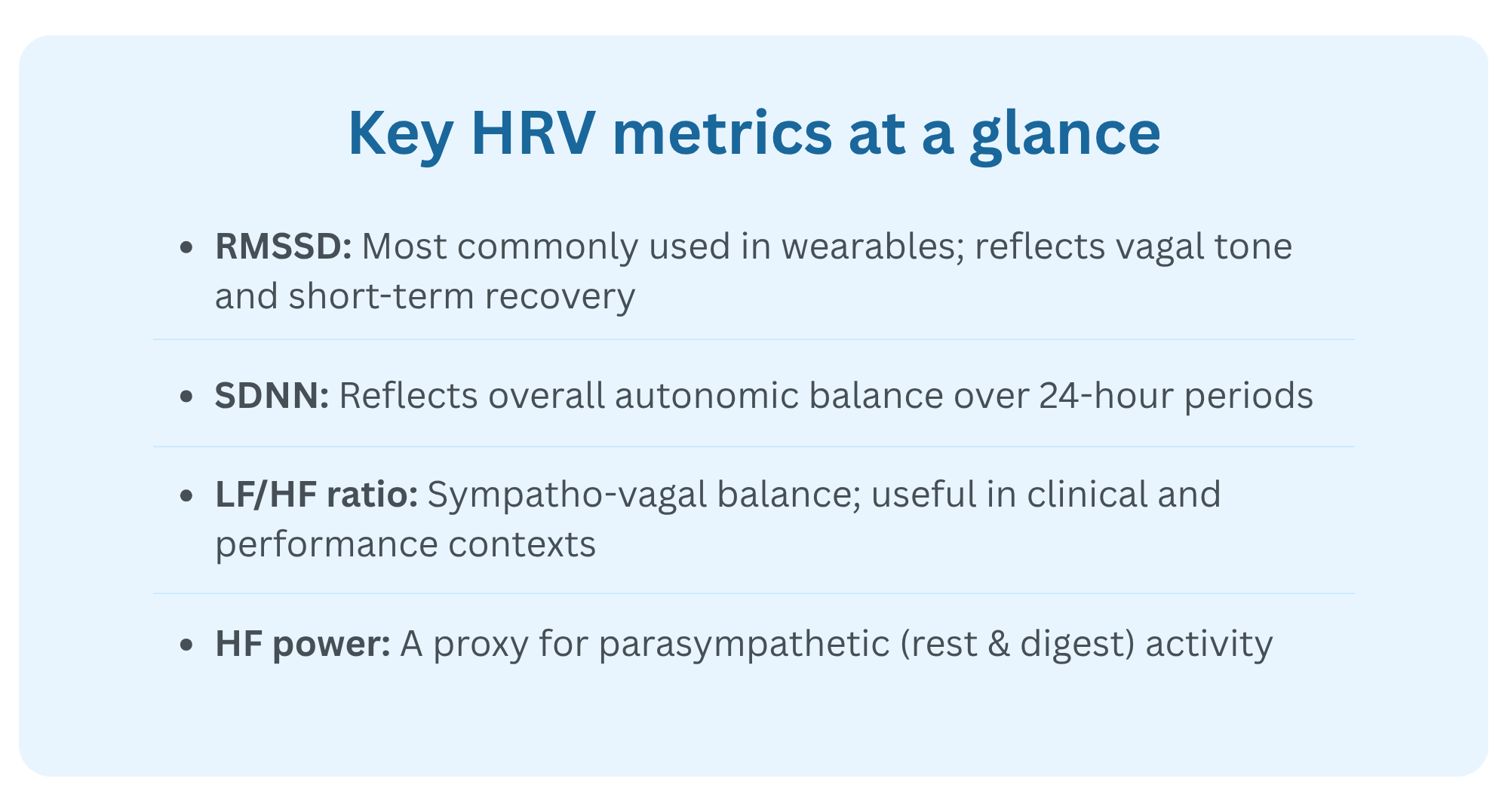
The simplest method. It measures the raw variation in R-R intervals over a set time window. The most common metric is SDNN (Standard Deviation of Normal-to-Normal intervals). A higher SDNN reflects greater overall autonomic balance and adaptability. Another common measure is RMSSD (Root Mean Square of Successive Differences), which is particularly sensitive to parasympathetic activity and commonly used in wearable devices.
Frequency-domain analysis
A more sophisticated approach that decomposes HRV into different frequency bands, each reflecting different aspects of ANS activity. The high-frequency (HF) band is a marker of parasympathetic (vagal) tone (what we often associate with "recovery"). The low-frequency (LF) band reflects a mixture of both sympathetic and parasympathetic activity.
What is considered a "good" HRV?
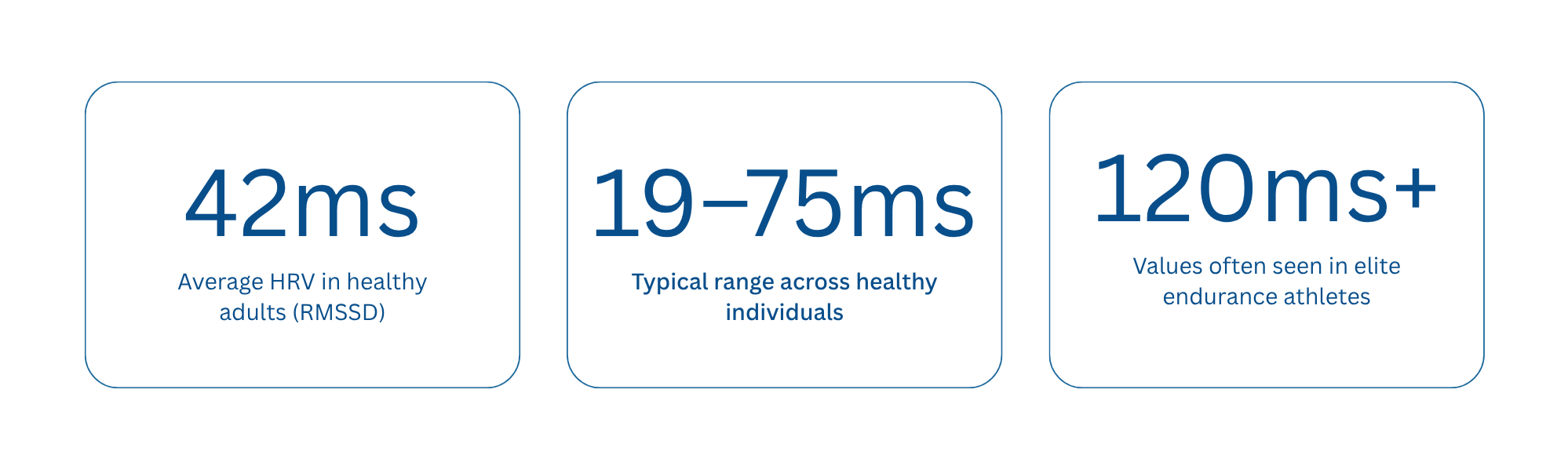
This is one of the most common questions I get in clinic, and the honest answer is: it depends. HRV is highly individual, and comparison to population averages is less useful than tracking your own trends over time.
Factors that influence your baseline
Individual HRV is shaped by
Age: HRV naturally declines with age as ANS responsiveness decreases
Sex: Men tend to have slightly higher HRV on average, though this difference narrows with age
Fitness level: Regular aerobic training is one of the most reliable ways to raise baseline HRV
Genetics: Intrinsic ANS function varies between individuals regardless of lifestyle
Environment: Temperature, altitude, air quality and circadian disruption all affect HRV acutely
Lifestyle load: Sleep debt, alcohol, processed food, and psychological stress all suppress HRV
The most useful approach in clinical practice is to establish your baseline over 2–4 weeks of consistent morning measurements, then track deviations from that norm. A single reading tells you very little. A trend tells you everything.
Why does HRV matter for your health?
From a functional medicine standpoint, HRV matters because it's one of the few non-invasive markers that reflects the integrated output of your nervous system, cardiovascular system, sleep, stress load, and inflammatory status; all in a single number.
Recovery and training readiness
A high HRV signals that your sympathetic and parasympathetic systems are well-balanced, meaning your body has the reserve capacity to handle a training stimulus and adapt to it. A suppressed HRV after hard training or poor sleep is your nervous system signalling it needs more time… not more stress.
Cardiovascular resilience
Low HRV is associated with reduced cardiovascular flexibility and higher autonomic dysfunction risk. It is not a diagnostic tool for heart disease, but it does reflect how well your cardiovascular system adapts to physiological demands.
Stress resilience and emotional regulation
Chronic psychological stress is one of the fastest ways to suppress HRV. The bidirectional relationship between mental state and vagal tone means that improving HRV often improves your capacity to manage stress, and vice versa. This is why HRV is increasingly used in mental health and performance psychology contexts.
Sleep quality
HRV rises during deep, restorative sleep as parasympathetic activity dominates. A consistently low overnight HRV is often a flag that sleep quality is poor, even if the person reports sleeping a full 7–8 hours. This is particularly relevant in functional medicine where we look at sleep architecture, not just duration.
Inflammation and immune load
This is an underappreciated connection. Systemic inflammation from gut dysbiosis, food sensitivities, chronic infections, or environmental toxin exposure, chronically activates the sympathetic nervous system and suppresses vagal tone. In practice, I often see HRV improve significantly when we address underlying inflammatory drivers, even before sleep or exercise changes are made.
Measuring HRV: tools and technology
Accuracy varies considerably across measurement methods. Here's how the main options stack up:
HRV measurement options compared
ECG / Polar H10 chest strap: Gold standard for accuracy. Captures R-R intervals directly. Best for clinical or research-grade measurement. The Polar H10 paired with apps like Elite HRV gives near-ECG accuracy.
Optical wearables (Apple Watch, Garmin, WHOOP, Oura Ring): Use photoplethysmography (PPG) via light sensors on the skin. Accurate enough for trend tracking. Less reliable during movement. WHOOP and Oura specifically optimise for overnight HRV capture.
Smartphone camera apps: The camera and flash detect changes in fingertip blood flow. Useful for occasional spot-checks; not reliable enough for consistent longitudinal tracking.
For most of my patients, I recommend a chest strap or a quality ring/wrist device used consistently at the same time each morning, ideally upon waking, before getting out of bed. Consistency of measurement conditions matters as much as the device you choose.
How to improve your HRV: practical strategies
HRV is not a fixed trait. It's a modifiable marker that responds (sometimes quickly) to lifestyle inputs. Here are the strategies with the strongest evidence base and the ones I use with patients in clinic.
Sleep Quality
Consistent sleep timing, cool and dark environment, and minimising blue light are foundational. Poor sleep is the fastest way to tank HRV.
Aerobic Exercise
Moderate intensity cardio 3 to 5 times per week is one of the most reliable HRV boosters. Avoid overtraining. Watch your HRV trend the morning after sessions.
Breathwork
Slow diaphragmatic breathing at 5 to 6 breaths per minute directly stimulates the vagus nerve. Even 5 minutes daily has measurable HRV effects.
Stress Management
Meditation, mindfulness, yoga, and nature exposure all raise vagal tone. Chronic unmanaged stress is a potent HRV suppressant.
Nutrition and Hydration
Whole foods, adequate hydration, and limiting alcohol are essential. Gut health and inflammation are directly linked to vagal tone.
Consistency Over Time
HRV improvements typically take weeks to months. Track trends, not daily numbers. Small consistent changes compound significantly.
The vagus nerve: your HRV lever
The vagus nerve is the primary pathway of parasympathetic tone, and therefore one of the most direct ways to influence HRV. Beyond breathwork, emerging clinical tools for vagal stimulation include Frequency Specific Microcurrent (FSM), cold water exposure (particularly facial/neck), humming and singing, and biofeedback-based HRV training using tools like HeartMath or BioSign HRV. These represent a growing area of both clinical practice and performance optimisation.
A note on supplements
Several evidence-supported nutritional supports may aid HRV through their effects on inflammation, nervous system function, and cellular recovery. These include omega-3 fatty acids (EPA/DHA), magnesium glycinate or threonate, adaptogenic herbs (ashwagandha, rhodiola), and targeted mitochondrial support. Always work with a practitioner to identify what's appropriate for your individual context… this is not a one-size-fits-all area.
HRV and the brain: an emerging frontier
The relationship between HRV and brain function is one of the most exciting areas in neuroscience right now. The heart and brain are in constant bidirectional communication via the vagus nerve, and HRV is increasingly recognised as a biomarker of not just cardiovascular health, but cognitive performance and neurological resilience.
Research is finding associations between HRV and emotional regulation capacity, working memory, executive function, and prefrontal cortex activity. Reduced HRV has been observed in conditions including depression, anxiety, ADHD, dementia, and post-stroke recovery. This heart-brain axis is central to a "brain-based" model of functional health — the idea that optimising nervous system function from the bottom up has wide-ranging effects on how we think, feel, and perform.
It also explains why so many of our most effective interventions (breathwork, cold exposure, movement, community, sleep) work through the nervous system first. HRV is the measurable signal of that system's health.
FAQs
-
For general tracking, once daily in the morning (before getting out of bed, ideally using a chest strap or quality wearable) is sufficient. If you're in a structured training block or monitoring recovery from illness, daily measurement allows you to make more responsive decisions about training load. Focus on 7-day rolling averages rather than individual readings.
-
Some changes; like the acute effect of a breathwork session or alcohol on HRV. happen within hours to days. Structural improvements to your baseline from exercise, sleep, and stress management typically take 4–12 weeks of consistent effort. Root-cause interventions (addressing gut dysbiosis, chronic inflammation, sleep disorders) may produce slower but more sustained shifts.
-
Comparison has limited value. A 45ms RMSSD might be excellent for a 55-year-old sedentary individual and a concern for a competitive athlete. Your own trend over time (how your HRV changes in response to specific inputs) is far more clinically useful than where you sit on a population chart.
-
Not necessarily. While higher HRV generally indicates better recovery and autonomic balance, extremely high HRV relative to your baseline can sometimes reflect an overshooting parasympathetic response, or may occur in the context of certain cardiac irregularities. Context matters, which is why interpretation should always sit within a broader clinical picture.
-
Yes. Beta-blockers reduce HRV by dampening sympathetic drive. Certain antidepressants, anxiolytics, and other medications affecting ANS function can also shift HRV. If you're on medications and tracking HRV, note any changes around medication adjustments and discuss them with your prescribing clinician.
-
HRV can signal patterns of autonomic dysfunction associated with elevated cardiovascular risk, but it is not a diagnostic tool. It should not be used to self-diagnose or replace clinical assessment. If you have cardiovascular concerns, please consult your GP or cardiologist for appropriate investigation.
Want to know what your HRV is telling you?
At Wave Functional Health, we integrate HRV assessment with comprehensive functional medicine evaluation to get to the root of why you're not recovering the way you should.